JCRB1475 Nalm-6-MSH+
Cell information
Important Notice(s)JCRB1475 Nalm-6-MSH+ : Condition for Distribution [分譲の条件]
Cell type:general cells (View Pricing Information)
| JCRB No. | JCRB1475 | Cell Name | Nalm-6-MSH+ |
|---|---|---|---|
| Profile | Human cell line derived from B cell leukemia. (MSH+, POL(WT), TK+/-) | Other Name | |
| Animal | human | Strain | |
| Genus | Homo | Species | sapiens |
| Sex | M | Age | 19-year-old |
| Identity | available | Tissue for Primary Cancer | |
| Case history | acute lymphoblastic leukemia (ALL) | Metastasis | |
| Tissue Metastasized | Genetics | MSH+, POL(WT), TK+/- | |
| Life Span | infinite | Crisis PDL | |
| Morphology | lymphocyte-like | Character | |
| Classify | tumor | Established by | |
| Registered by | Nohmi, T. | Regulation for Distribution | Cite the litarature specified by the developer at the publication of papers using this cell line. |
| Comment | Year | 2012 | |
| Medium | RPMI 1640 + 10% heat-inactivate FBS | Methods for Passages | dilution |
| Cell Number on Passage | twice/week, split ratio = 1:10 | Race | |
| CO2 Conc. | 5% | Tissue Sampling | peripheral blood |
| Tissue Type |
| Detection of virus genome fragment by Real-time PCR | |||||||||
|---|---|---|---|---|---|---|---|---|---|
| Detected DNA Virus | tested | Detected RNA Virus | tested | ||||||
| CMV | - | parvoB19 | - | HCV | - | HTLV-1 | - | ||
| EBV | - | HBV | - | HIV-1 | - | HTLV-2 | - | ||
| HHV6 | - | HTLV-1 | - | HIV-2 | - | HAV | - | ||
| HHV7 | - | HTLV-2 | - |
-/negative. +/positive. nt/not tested. (positive (+) does not immediately mean the production of infectious viral particles.) |
|||||
| BKV | - | HIV-1 | - | ||||||
| JCV | - | HIV-2 | - | ||||||
| ADV | - | HPV18 | - | ||||||
| Notes | |||||||||
| Reference | |
|---|---|
| Pubmed id:27338670 | Sensitivity of human cells expressing low-fidelity or weak-catalytic-activity variants of DNA polymerase ζ to genotoxic stresses. Suzuki T,Grúz P,Honma M,Adachi N,Nohmi T DNA Repair (Amst). 2016 Sep;45():34-43 |
| Pubmed id:23596518 | Restoration of mismatch repair functions in human cell line Nalm-6, which has high efficiency for gene targeting. Suzuki T,Ukai A,Honma M,Adachi N,Nohmi T PLoS One. 2013;8(4):e61189 |
| Images |
|---|
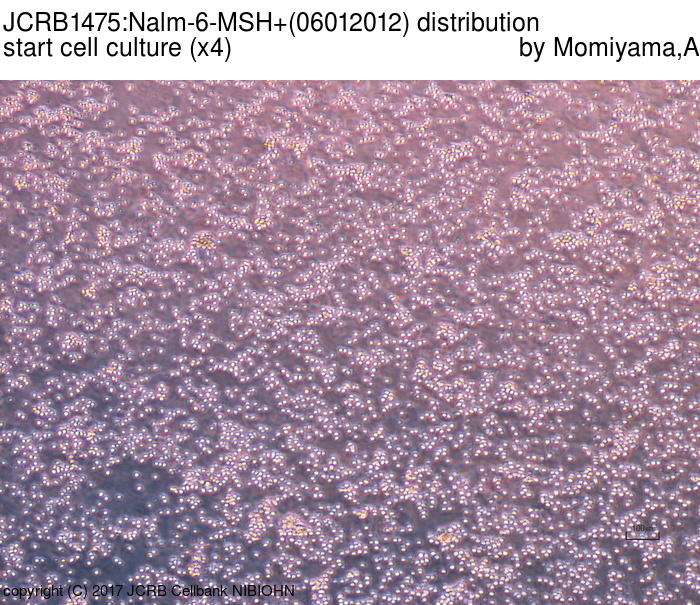 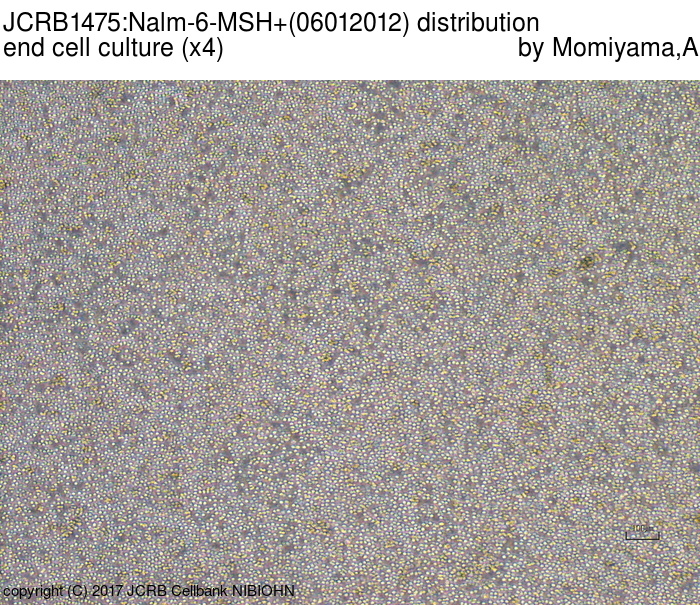 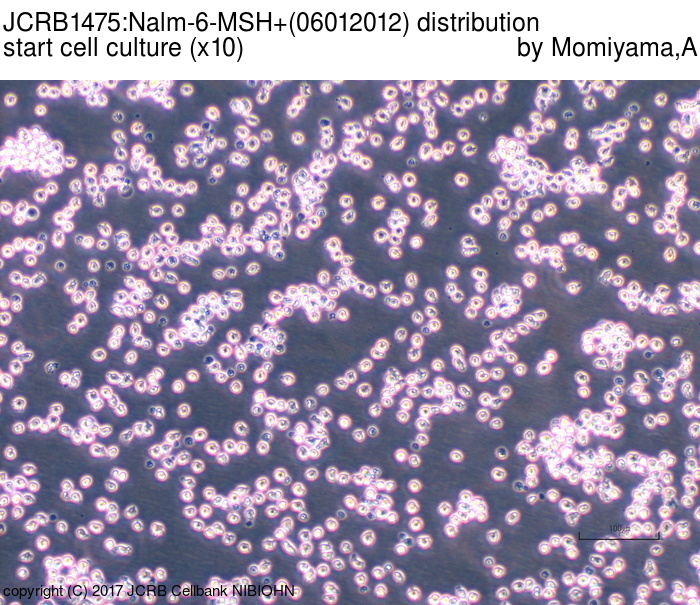 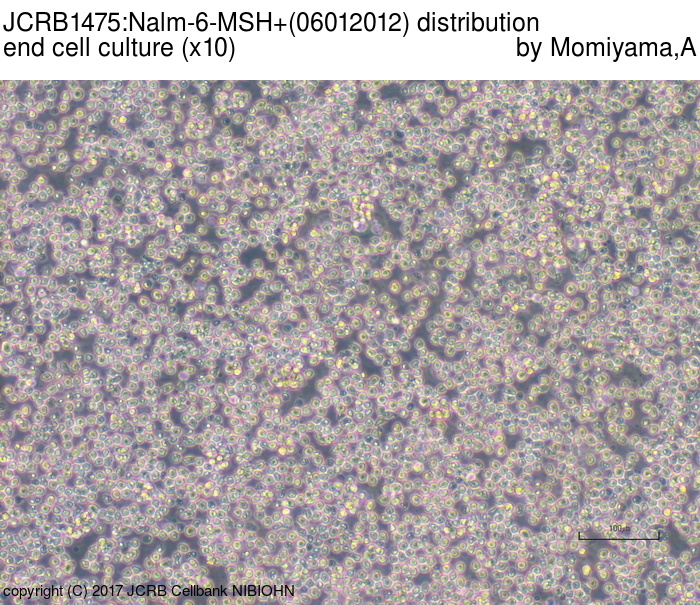 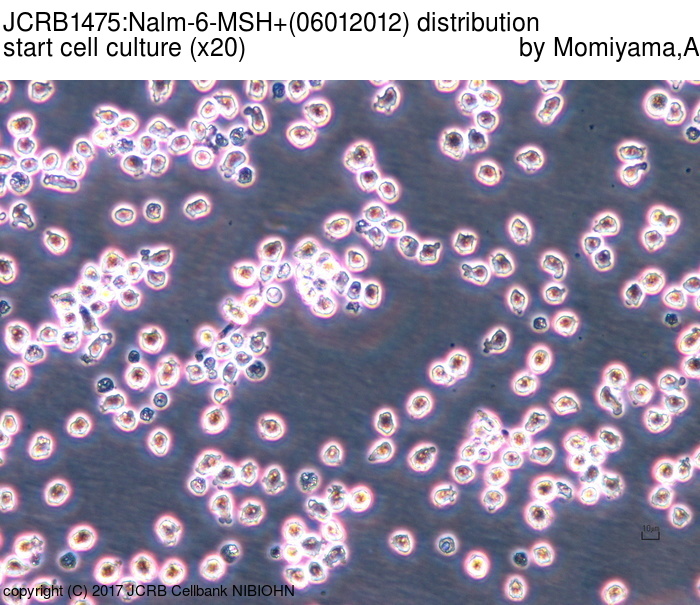 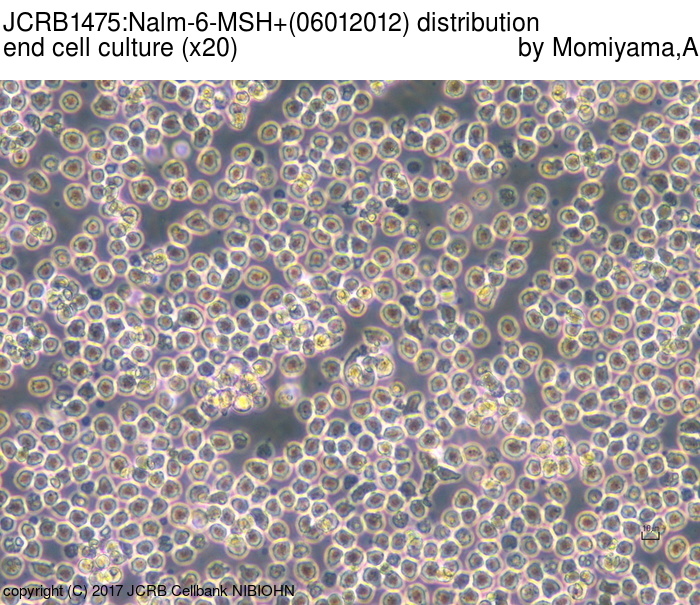  |
LOT Information
Viability/Growth rate/Cell number are represented as actual values measured at lot presentation in JCRB, but are not guaranteed values. Additionally, the doubling time is a rough value measured during passages.| Cell No. | JCRB1475 | Cell Name | Nalm-6-MSH+ |
|---|---|---|---|
| LOT No. | 06012012 | Lot Specification | distribution |
| Medium | RPMI1640 medium(GIBCO) with 10% heat inactivated fetal bovine serum(SIGMA027K03911) | Temperature | 37 C |
| Cell Density at Seeding | 0.1-2.0x10^6 cells/ml | Methods for Passages | Dilution(1/10),twice/week |
| Doubling Time | NT | Cell Number in Vial (cells/1ml) | 3.9x10^6 |
| Viability at cell freezing (%) | 85.9 | Antibiotics Used | free |
| Passage Number | p3* | PDL | NT |
| Sterility: MYCOPLASMA | - | Sterility: BACTERIA | - |
| Sterility: FUNGI | - | Isozyme Analysis | NT |
| Chromosome Mode | NT | Chromosome Information | NT |
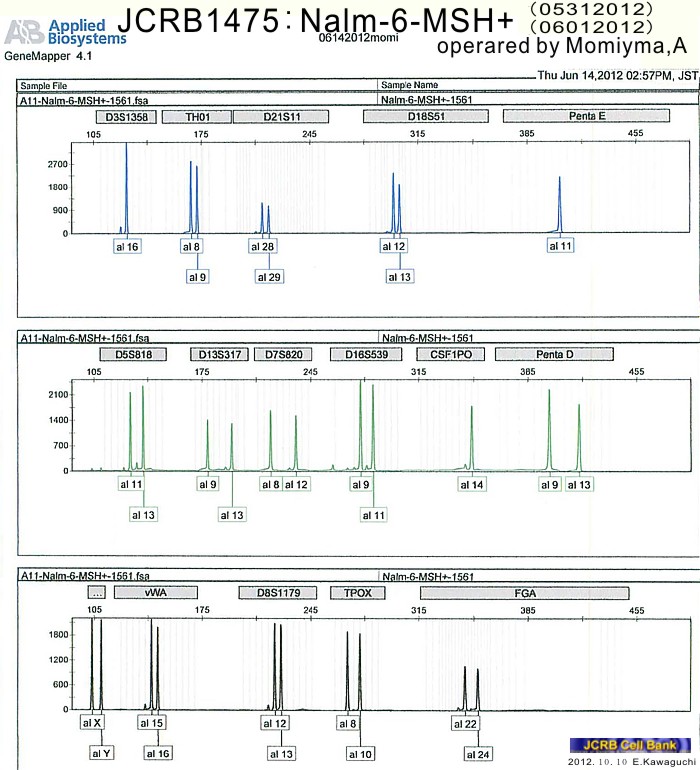
| Surface Antigen | NT | DNA Profile (STR) | D5S818:11,13 D13S317:9,13 D7S820:8,12 D16S539:9,11 VWA:15,16 TH01:8,9 AM:X,Y TPOX:8,10 CSF1PO:14 |
| Adhesion | No | Exoteric Gene | NT |
| Medium for Freezing | Cell Banker BLC-1(Nihon Zenyaku Industries) | CO2 Conc. | 5 % |
| Viability immediately after thawing (%) | Additional information |
| Images |
|---|
|
|
| Cell No. | JCRB1475 | Cell Name | Nalm-6-MSH+ |
|---|---|---|---|
| LOT No. | 01192018 | Lot Specification | distribution |
| Medium | RPMI 1640 medium with 10% heat-inactivated fetal bovine serum (FBS; Sigma Cat. # 172012) | Temperature | 37 C |
| Cell Density at Seeding | 1 - 2 x 10^5 cells/mL | Methods for Passages | Simple dilution (suspension culture). |
| Doubling Time | approx. 1 day. | Cell Number in Vial (cells/1ml) | 4.4 x 10^6 |
| Viability at cell freezing (%) | 86 | Antibiotics Used | free |
| Passage Number | Unknown (6 at bank) | PDL | |
| Sterility: MYCOPLASMA | - | Sterility: BACTERIA | - |
| Sterility: FUNGI | - | Isozyme Analysis | |
| Chromosome Mode | Chromosome Information | ||
| Surface Antigen | DNA Profile (STR) | ||
| Adhesion | No | Exoteric Gene | |
| Medium for Freezing | 10% DMSO, 20% FBS - RPMI1640 | CO2 Conc. | 5% |
| Viability immediately after thawing (%) | 86 | Additional information |